
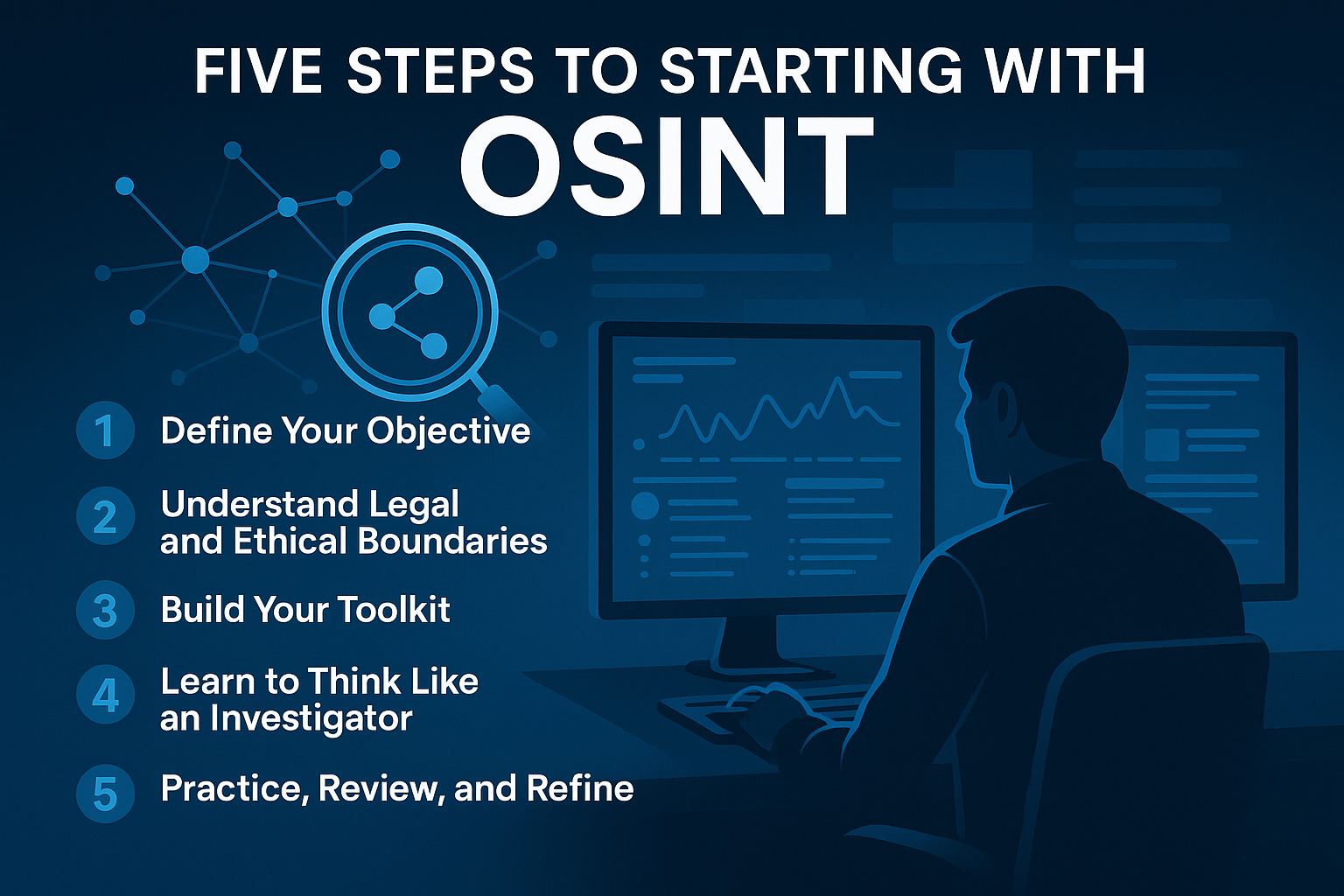
In the digital age, information is everywhere — but finding, verifying, and understanding it is what sets an investigator apart.
That’s where OSINT (Open-Source Intelligence) comes in.
Whether you’re a journalist, researcher, cybersecurity analyst, or simply curious about the world of digital investigation, OSINT offers powerful ways to uncover publicly available data.
But where do you begin?
This guide outlines five essential steps to help you start your OSINT journey the right way — securely, ethically, and effectively.
🧭 Step 1: Define Your Objective
Before you even open a browser tab, define what you’re looking for.
OSINT isn’t about collecting random data — it’s about pursuing specific, actionable information with a clear goal.
Ask yourself:
- What question am I trying to answer?
- Who or what is the focus of my research?
- What would “done” look like?
A clear objective keeps your investigation efficient and focused, helping you avoid data overload.
🧠 Step 2: Understand Legal and Ethical Boundaries
OSINT operates in the open, but that doesn’t mean everything you find is fair game.
Different countries and platforms have varying laws around data collection, privacy, and consent.
As a rule:
- Only use publicly available information.
- Respect platform terms of service.
- Avoid intrusive or deceptive methods.
Ethics are the backbone of credible OSINT work.
Good investigators protect privacy, even while uncovering the truth.
🛠️ Step 3: Build Your Toolkit
You don’t need expensive software to get started — many powerful OSINT tools are free and open-source.
Begin with the essentials:
- Search Engines: Google Advanced Search, Bing, DuckDuckGo, or SearXNG
- Social Media Analysis: Maigret, Sherlock, Blackbird, or Social Analyzer
- Website Investigation: WHOIS, DNSDumpster, Shodan
- Image & Metadata Tools: ExifTool, FotoForensics, and reverse image search
- Note-Taking & Data Management: Obsidian, Notion, or spreadsheets
Start small. Master each tool, understand what it reveals, and how it fits into your workflow.
🕹️ Step 4: Learn to Think Like an Investigator
Tools don’t make an investigator — mindset does.
The real skill in OSINT is the ability to connect dots that others overlook.
Develop habits such as:
- Cross-verifying information from multiple sources
- Tracking and documenting every search (your audit trail)
- Recognizing patterns, anomalies, and relationships
- Using logical reasoning, not assumptions
OSINT isn’t just data collection — it’s data interpretation.
The goal is insight, not noise.
🧩 Step 5: Practice, Review, and Refine
OSINT is a skill that grows through practice and reflection.
Start small — investigate a topic of public interest, a company, or a historic event.
Test new tools, record your process, and learn from each result.
Periodically review:
- What worked well?
- What produced false leads?
- How could your workflow improve?
The best OSINT practitioners evolve constantly — adapting to new platforms, technologies, and information landscapes.
🔐 Final Thoughts
OSINT is one of the most empowering skills in the modern world.
It helps you see through misinformation, uncover hidden truths, and make informed decisions — all using information that’s freely available to anyone.
But remember:
With great access comes great responsibility.
Start with clear goals, stay ethical, protect your digital footprint, and never stop learning.
That’s the foundation of real Open-Source Intelligence.