I’m often asked the same question:
“What’s the best tool to use for an investigation?”
It’s a fair question — but also the wrong one.
OSINT tools are powerful, yes. They can automate searches, visualise data, and scrape massive amounts of open-source information in seconds.
But tools alone don’t make an investigator; you need OSINT Investigation Skills.
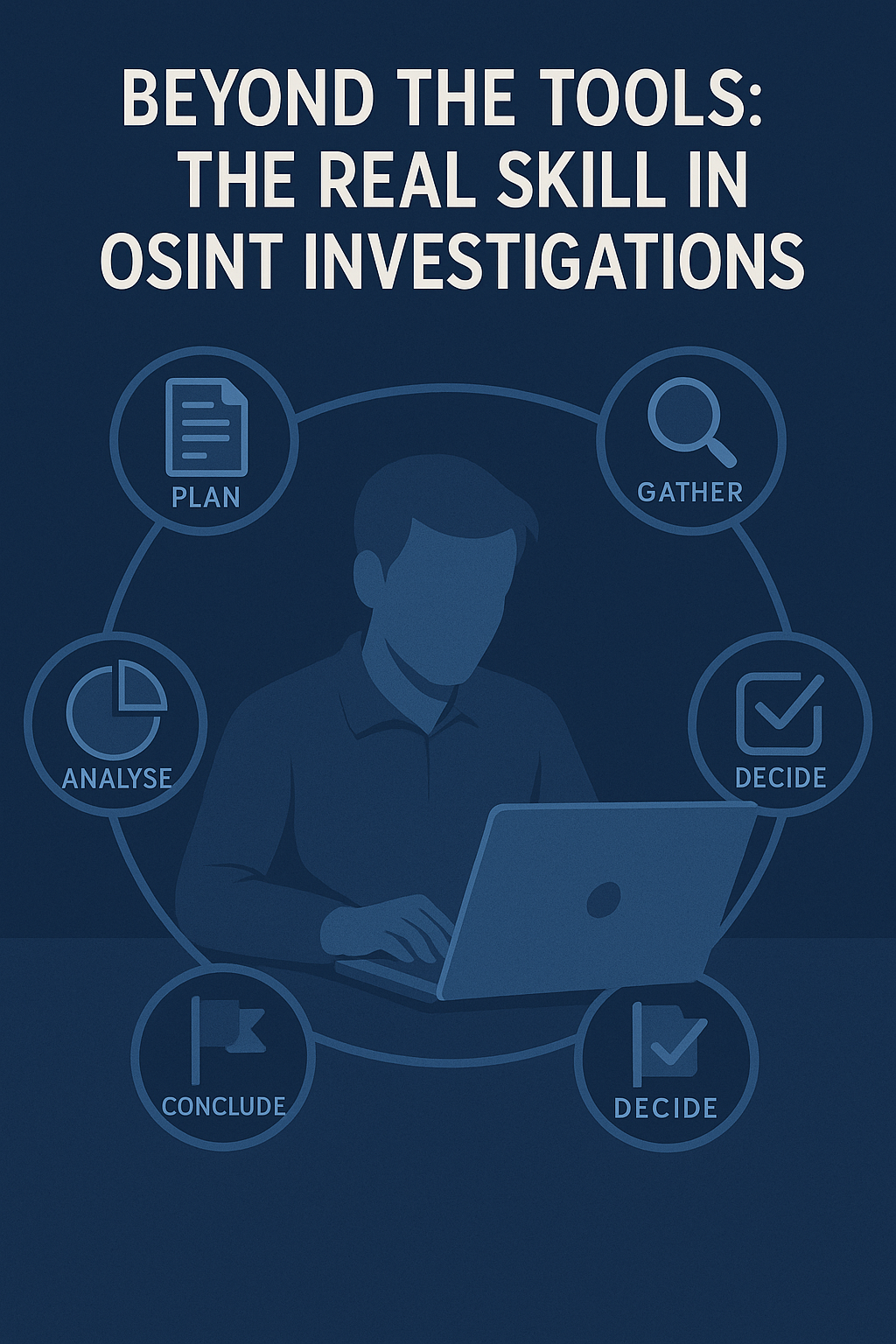
The true art of OSINT lies in how you think — how you plan, collect, analyse, and interpret information.
Defining the Goal Before You Open Any Tool
Every professional investigation begins with understanding the objective.
If you don’t know what you’re trying to achieve, you’ll waste time chasing irrelevant data.
When I take on a new case, the first step is to talk to the client or team and clarify the scope:
- What do we want to know?
- Why do we need to know it?
- What would a successful result look like?
- What boundaries exist (legal, ethical, or resource-based)?
This conversation shapes the direction of the entire investigation.
For example, if a client asks me to find out who owns a suspicious domain, I don’t immediately run a WHOIS lookup.
I start by asking:
- When did this domain first appear?
- What other domains might be linked to it?
- What harm or risk does it represent?
The answers determine which threads to follow — and which to ignore. Using Good and effective OSINT Investigation skills is essential to performing a good overall investigation. Never be afraid to ask a client what they are looking to achieve and move forward with the investigation. You may be surprised.
Information Gathering: Tools Are Just Helpers
Once the goal is defined, tools come into play — but in a supporting role.
Think of tools as your assistants, not your decision-makers.
For example:
- You might use Maigret or Blackbird to check if a username exists across platforms.
- Use WhoisXML, DNSDumpster, or Shodan to examine technical infrastructure.
- Use Google advanced search operators to locate PDFs, reports, or historical traces.
Each one contributes a piece of the puzzle.
But unless you know what that puzzle looks like, you’ll never know when the pieces fit.
Good investigators don’t rely on a single platform — they combine multiple tools and, more importantly, interpret results with context and scepticism. More information about OSINT Tools and Investigation skill in my book “Shadows of Information, An OSINT Guide
Analysis: The Core of an Investigation
Here’s where many beginners get lost. They collect vast amounts of data, yet fail to analyse it.
Analysis is about connecting the dots:
- What does this new piece of information mean?
- How does it change what I already know?
- Does it open a new thread — or close an old one?
A good investigator always thinks in threads.
You follow one lead until it reaches a dead end or produces something relevant. Then you pivot to another — but only if it aligns with your objectives.
For example:
If I’m researching a suspected fraudulent company and I find a LinkedIn profile of someone claiming to be a director, that’s a thread worth following.
But if I find 20 anonymous comments about the company on random forums, that’s noise — not a lead.
Following Threads vs. Chasing Noise
Real investigations are messy. You’ll encounter red herrings, false positives, and coincidences that appear to be connections.
One of the primary keys to good OSINT investigation Skills is judgment — knowing what’s relevant.
Here’s a real-world style example (fictionalised for privacy):
I once investigated a small e-commerce site linked to counterfeit goods. The client wanted to identify the operator.
The first domain lookup showed privacy protection — a dead end.
However, by analysing server IPs and historical DNS data, I noticed a connection to another website hosting similar products.
That second domain used the same Google Analytics ID.
Bingo — a real, actionable thread.
Meanwhile, dozens of other data points (forum usernames, reviews, social comments) looked interesting but led nowhere. Following them would have been a waste of time and money.
Relevance Is Everything
This is where experience and intuition matter most.
A skilled investigator constantly asks:
- “Is this relevant to my objective?”
- “Does this finding add value for the client?”
- “Am I solving their problem — or just collecting data?”
If you can’t answer those questions clearly, it’s time to pause, review your notes, and realign your direction.
There’s no point following a thread that doesn’t support the investigation goal.
An investigation should always move you closer to understanding, not simply deeper into the web.
The OSINT Investigator’s Mindset
The most effective investigators I know share everyday habits:
- They are curious, but disciplined.
- They document everything — timestamps, sources, reasoning.
- They know when to stop collecting and start analysing.
- They treat every OSINT tool as part of a broader methodology, not a magic bullet.
Because at the end of the day:
OSINT tools don’t solve cases — investigators do.
Tools make you faster; thinking makes you effective.
Key Takeaways
- Define your objective and scope before using any tool.
- Gather structured information — know what you’re looking for.
- Analyse continuously: highlight threads, assess new ones, and decide which to pursue.
- Stay aligned with the client’s goals at all times.
- Remember: OSINT tools are extensions of your skills, not replacements for them.
Final Thought
Every investigation is a journey through information — and your map is your investigative process.
The best investigators aren’t the ones with the biggest toolkits; they’re the ones who know how to ask the right questions, think critically, and stay focused on relevance.
Master your process, and the tools will follow your lead — not the other way around. I was fortunate enough to have an amazing mentor who taught me the importance of thorough investigations and keeping my eye on the goal. Remember, Keep It Relevant and document your journey through each investigation.